ââ‹the Narratives That Make Up the Verbal Arts Include All of the Following Except

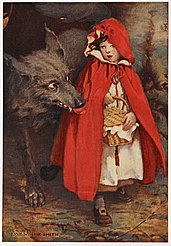
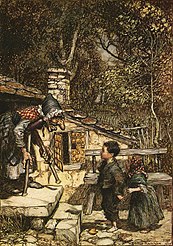
Folklore is the body of culture shared by a particular grouping of people; it encompasses the traditions common to that civilisation, subculture or group. This includes oral traditions such as tales, legends,[1] proverbs and jokes. They include fabric culture, ranging from traditional building styles to handmade toys common to the group. Folklore as well includes customary lore, taking deportment for folk beliefs, the forms and rituals of celebrations such every bit Christmas and weddings, folk dances and initiation rites. Each one of these, either singly or in combination, is considered a folklore artifact. But equally essential equally the form, folklore also encompasses the manual of these artifacts from i region to another or from ane generation to the next. Folklore is not something ane tin typically proceeds in a formal school curriculum or study in the fine arts. Instead, these traditions are passed along informally from one individual to some other either through verbal instruction or sit-in. The academic written report of folklore is chosen folklore studies or folkloristics, and information technology tin can be explored at undergraduate, graduate and Ph.D. levels.[two]
Overview [edit]
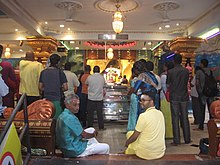
Indian Folk Worship at Batu Caves, Selangor Malaysia


Serbian Folk Group, Music and Costume. A grouping of performers sharing traditional Serbian folk music on the streets of Belgrade, Serbia.
The word sociology, a chemical compound of folk and lore, was coined in 1846 by the Englishman William Thoms,[3] who contrived the term as a replacement for the contemporary terminology of "popular antiquities" or "popular literature". The second one-half of the word, lore, comes from Old English lār 'education'. It is the knowledge and traditions of a detail grouping, frequently passed along by word of mouth.[four]
The concept of folk has varied over time. When Thoms first created this term, folk applied only to rural, frequently poor and illiterate peasants. A more modernistic definition of folk is a social grouping that includes two or more persons with mutual traits, who limited their shared identity through distinctive traditions. "Folk is a flexible concept which can refer to a nation as in American folklore or to a unmarried family."[5] This expanded social definition of folk supports a broader view of the material, i.due east. the lore, considered to exist folklore artifacts. These at present include all "things people make with words (verbal lore), things they make with their hands (fabric lore), and things they make with their actions (customary lore)".[6] Folklore is no longer considered to be express to that which is old or obsolete. These folk artifacts continue to exist passed along informally, equally a rule anonymously, and always in multiple variants. The folk grouping is not individualistic, information technology is community-based and nurtures its lore in community. "As new groups emerge, new sociology is created… surfers, motorcyclists, computer programmers".[7] In direct contrast to high culture, where whatsoever single piece of work of a named creative person is protected by copyright law, folklore is a function of shared identity within a common social group.[8]
Having identified folk artifacts, the professional folklorist strives to sympathise the significance of these beliefs, customs, and objects for the group, since these cultural units[9] would not be passed along unless they had some continued relevance within the group. That meaning tin can however shift and morph, for case: the Halloween commemoration of the 21st century is non the All Hallows' Eve of the Centre Ages, and even gives rise to its own set of urban legends independent of the historical celebration; the cleansing rituals of Orthodox Judaism were originally proficient public wellness in a land with little water, but now these customs signify for some people identification equally an Orthodox Jew. By comparison, a common action such as tooth brushing, which is likewise transmitted within a group, remains a practical hygiene and health result and does not ascension to the level of a grouping-defining tradition.[10] Tradition is initially remembered behavior; one time it loses its practical purpose, there is no reason for further transmission unless it has been imbued with meaning beyond the initial practicality of the action. This significant is at the core of folkloristics, the written report of sociology.[eleven]
With an increasingly theoretical sophistication of the social sciences, information technology has become axiomatic that folklore is a naturally occurring and necessary component of any social group; information technology is indeed all around the states.[12] Folklore does not have to be former or blowsy, information technology continues to be created and transmitted, and in any group it is used to differentiate between "usa" and "them".
Origin and development of folklore studies [edit]
Folklore began to distinguish itself equally an democratic subject during the menses of romantic nationalism in Europe. A particular figure in this development was Johann Gottfried von Herder, whose writings in the 1770s presented oral traditions as organic processes grounded in locale. After the High german states were invaded past Napoleonic France, Herder's approach was adopted by many of his fellow Germans who systematized the recorded folk traditions and used them in their process of nation building. This process was enthusiastically embraced by smaller nations like Finland, Estonia, and Hungary, which were seeking political independence from their dominant neighbours.[thirteen]
Folklore as a field of study further developed among 19th century European scholars who were contrasting tradition with the newly developing modernity. Its focus was the oral folklore of the rural peasant populations, which were considered equally rest and survivals of the past that connected to exist within the lower strata of lodge.[14] The "Kinder- und Hausmärchen" of the Brothers Grimm (get-go published 1812) is the all-time known but by no means only collection of exact folklore of the European peasantry of that time. This interest in stories, sayings and songs connected throughout the 19th century and aligned the fledgling discipline of folkloristics with literature and mythology. By the turn into the 20th century the number and composure of folklore studies and folklorists had grown both in Europe and North America. Whereas European folklorists remained focused on the oral folklore of the homogenous peasant populations in their regions, the American folklorists, led by Franz Boas and Ruth Benedict, chose to consider Native American cultures in their research, and included the totality of their customs and beliefs equally folklore. This distinction aligned American folkloristics with cultural anthropology and ethnology, using the same techniques of data collection in their field research. This divided alliance of folkloristics betwixt the humanities in Europe and the social sciences in America offers a wealth of theoretical vantage points and inquiry tools to the field of folkloristics as a whole, even as information technology continues to exist a point of give-and-take inside the field itself.[15]
The term folkloristics, along with the culling name folklore studies,[notation i] became widely used in the 1950s to distinguish the academic study of traditional civilization from the folklore artifacts themselves. When the American Folklife Preservation Act (Public Law 94-201) was passed by the U.S. Congress in January 1976,[16] to coincide with the Bicentennial Commemoration, folkloristics in the United states came of age.
"…[Folklife] ways the traditional expressive culture shared within the diverse groups in the United States: familial, ethnic, occupational, religious, regional; expressive culture includes a wide range of creative and symbolic forms such as custom, belief, technical skill, language, literature, art, architecture, music, play, trip the light fantastic toe, drama, ritual, pageantry, handicraft; these expressions are mainly learned orally, by imitation, or in performance, and are generally maintained without benefit of formal instruction or institutional direction."
Added to the all-encompassing array of other legislation designed to protect the natural and cultural heritage of the U.s.a., this law besides marks a shift in national awareness. It gives voice to a growing understanding that cultural diverseness is a national strength and a resource worthy of protection. Paradoxically, it is a unifying characteristic, non something that separates the citizens of a state. "We no longer view cultural difference equally a problem to be solved, just as a tremendous opportunity. In the diversity of American folklife we find a market teeming with the substitution of traditional forms and cultural ideas, a rich resource for Americans".[17] This diversity is celebrated annually at the Smithsonian Folklife Festival and many other folklife fests around the state.
At that place are numerous other definitions. Co-ordinate to William Bascom major article on the topic in that location are "four functions to folklore":[eighteen]
- Folklore lets people escape from repressions imposed upon them by lodge.
- Folklore validates culture, justifying its rituals and institutions to those who perform and notice them.
- Sociology is a pedagogic device which reinforces morals and values and builds wit.
- Folklore is a ways of applying social pressure and exercising social control.
Definition of "folk" [edit]
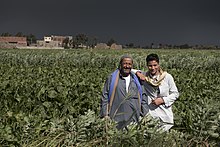

Folklore theater in Mansoura, Egypt
The folk of the 19th century, the social group identified in the original term "folklore", was characterized by being rural, illiterate and poor. They were the peasants living in the countryside, in contrast to the urban populace of the cities. Just toward the cease of the century did the urban proletariat (on the coattails of Marxist theory) go included with the rural poor every bit folk. The common feature in this expanded definition of folk was their identification as the underclass of society.[nineteen]
Moving forward into the 20th century, in tandem with new thinking in the social sciences, folklorists also revised and expanded their concept of the folk group. Past the 1960s it was understood that social groups, i.e. folk groups, were all around us; each individual is enmeshed in a multitude of differing identities and their concomitant social groups. The starting time group that each of us is born into is the family, and each family has its ain unique family folklore. Every bit a kid grows into an private, its identities also increase to include age, language, ethnicity, occupation, etc. Each of these cohorts has its ain sociology, and as one folklorist points out, this is "not idle speculation… Decades of fieldwork have demonstrated conclusively that these groups do have their own folklore."[vii] In this modern agreement, folklore is a role of shared identity within whatsoever social group.[8]
This sociology can include jokes, sayings and expected behavior in multiple variants, always transmitted in an informal fashion. For the most part it will be learned past observation, simulated, repetition or correction past other group members. This informal knowledge is used to ostend and re-inforce the identity of the group. Information technology can be used both internally within the group to limited their mutual identity, for example in an initiation anniversary for new members. Or it can be used externally to differentiate the grouping from outsiders, like a folkdance demonstration at a community festival. Pregnant to folklorists here is that there are two opposing but equally valid ways to apply this in the study of a group: you can start with an identified grouping in guild to explore its sociology, or yous can identify folklore items and utilize them to identify the social grouping.[xx]
Showtime in the 1960s, a further expansion of the concept of folk began to unfold through the written report of folklore. Private researchers identified folk groups that had previously been overlooked and ignored. One notable example of this is found in an event of the Journal of American Sociology, published in 1975, which is defended exclusively to articles on women's folklore, with approaches that had not come from a homo's perspective.[note 2] Other groups that were highlighted as part of this broadened agreement of the folk group were non-traditional families, occupational groups, and families that pursued the product of folk items over multiple generations.
Folklore genres [edit]

United Arab Emirates traditional folk dance, the women flip their hair sideways in brightly coloured traditional dress.
Individual folklore artifacts are commonly classified as one of three types: cloth, verbal or customary lore. For the virtually part self-explanatory, these categories include concrete objects (material folklore), common sayings, expressions, stories and songs (exact sociology), and behavior and ways of doing things (customary folklore). There is too a fourth major subgenre defined for children's sociology and games (childlore), equally the drove and estimation of this fertile topic is particular to school yards and neighborhood streets.[21] Each of these genres and their subtypes is intended to organize and categorize the sociology artifacts; they provide common vocabulary and consistent labeling for folklorists to communicate with each other.
That said, each antiquity is unique; in fact one of the characteristics of all sociology artifacts is their variation inside genres and types.[22] This is in direct dissimilarity to manufactured goods, where the goal in production is to create identical products and whatsoever variations are considered mistakes. It is even so just this required variation that makes identification and nomenclature of the defining features a claiming. And while this classification is essential for the field of study area of folkloristics, information technology remains merely labeling, and adds picayune to an understanding of the traditional development and meaning of the artifacts themselves.[23]
Necessary as they are, genre classifications are misleading in their oversimplification of the subject. Folklore artifacts are never self-contained, they practise not stand in isolation but are particulars in the self-representation of a community. Different genres are oftentimes combined with each other to marking an outcome.[24] So a birthday commemoration might include a song or formulaic mode of greeting the altogether child (verbal), presentation of a block and wrapped presents (material), likewise as customs to honor the individual, such as sitting at the head of the table, and blowing out the candles with a wish. In that location might also be special games played at birthday parties which are not generally played at other times. Adding to the complication of the interpretation, the birthday party for a 7-yr-onetime will not exist identical to the altogether party for that same child as a six-yr-old, even though they follow the same model. For each artifact embodies a single variant of a operation in a given time and space. The task of the folklorist becomes to identify within this surfeit of variables the constants and the expressed meaning that shimmer through all variations: honoring of the individual inside the circumvolve of family and friends, gifting to express their value and worth to the group, and of class, the festival nutrient and drink as signifiers of the event.
Verbal tradition [edit]

The formal definition of verbal lore is words, both written and oral, that are "spoken, sung, voiced forms of traditional utterance that show repetitive patterns."[25] Crucial here are the repetitive patterns. Verbal lore is not just whatever chat, but words and phrases befitting to a traditional configuration recognized by both the speaker and the audience. For narrative types by definition take consistent construction, and follow an existing model in their narrative form.[note iii] As just one elementary example, in English language the phrase "An elephant walks into a bar…" instantaneously flags the following text as a joke. It might be one yous've already heard, only it might be one that the speaker has just idea upward within the current context. Another example is the child'due south song Old MacDonald Had a Farm, where each functioning is distinctive in the animals named, their club and their sounds. Songs such as this are used to express cultural values (farms are important, farmers are old and weather-beaten) and teach children about different domesticated animals.[26]
Exact folklore was the original folklore, the artifacts defined past William Thoms equally older, oral cultural traditions of the rural populace. In his 1846 published call for assist in documenting antiquities, Thoms was echoing scholars from across the European continent to collect artifacts of verbal lore. By the beginning of the 20th century these collections had grown to include artifacts from around the globe and across several centuries. A system to organize and categorize them became necessary.[27] Antti Aarne published a first classification organization for folktales in 1910. This was later expanded into the Aarne–Thompson classification system by Stith Thompson and remains the standard classification arrangement for European folktales and other types of oral literature. As the number of classified oral artifacts grew, similarities were noted in items that had been collected from very dissimilar geographic regions, ethnic groups and epochs, giving rise to the Celebrated–Geographic Method, a methodology that dominated folkloristics in the first half of the 20th century.
When William Thoms get-go published his entreatment to document the verbal lore of the rural populations, it was believed these folk artifacts would die out as the population became literate. Over the past two centuries this conventionalities has proven to be incorrect; folklorists continue to collect verbal lore in both written and spoken form from all social groups. Some variants might have been captured in published collections, but much of it is even so transmitted orally and indeed continues to be generated in new forms and variants at an alarming rate.
Below is listed a small sampling of types and examples of verbal lore.
- Aloha
- Ballads
- Blessings
- Bluegrass
- Chants
- Charms
- Cinderella
- Country music
- Cowboy poesy
- Creation stories
- Curses
- English similes
- Epic verse
- Fable
- Fairy tale
- Folk belief
- Folk etymologies
- Folk metaphors
- Folk poetry
- Folk music
- Folksongs
- Folk voice communication
- Folktales of oral tradition
- Ghostlore
- Greetings
- Hog-calling
- Insults
- Jokes
- Keening
- Latrinalia
- Legends
- Limericks
- Lullabies
- Myth
- Oaths
- Leave-taking formulas
- Fakelore
- Place names
- Prayers at bedtime
- Proverbs
- Retorts
- Riddle
- Roasts
- Sagas
- Sea shanties
- Street vendors
- Superstition
- Tall tale
- Taunts
- Toasts
- Natural language-twisters
- Urban legends
- Give-and-take games
- Yodeling
Material culture [edit]

Horse and sulky weathervane, Smithsonian American Fine art Museum
The genre of material civilisation includes all artifacts that can be touched, held, lived in, or eaten. They are tangible objects with a physical presence, either intended for permanent utilize or to exist used at the side by side meal. Nigh of these folklore artifacts are single objects that have been created by mitt for a specific purpose; however, folk artifacts tin can also exist mass-produced, such as dreidels or Christmas decorations. These items continue to be considered folklore because of their long (pre-industrial) history and their customary use. All of these material objects "existed prior to and continue alongside mechanized industry. … [They are] transmitted beyond the generations and bailiwick to the aforementioned forces of conservative tradition and individual variation"[25] that are found in all folk artifacts. Folklorists are interested in the physical course, the method of manufacture or construction, the pattern of use, equally well every bit the procurement of the raw materials.[28] The meaning to those who both make and employ these objects is of import. Of primary significance in these studies is the circuitous balance of continuity over modify in both their design and their decoration.
Traditional highlanders' pins hand-made by a goldsmith in Podhale, Poland
In Europe, prior to the Industrial Revolution, everything was made by manus. While some folklorists of the 19th century wanted to secure the oral traditions of the rural folk before the populace became literate, other folklorists sought to identify hand-crafted objects before their production processes were lost to industrial manufacturing. Just as exact lore continues to be actively created and transmitted in today'southward culture, and then these handicrafts can nevertheless be institute all around u.s.a., with perchance a shift in purpose and significant. There are many reasons for continuing to handmake objects for use, for example these skills may exist needed to repair manufactured items, or a unique design might be required which is not (or cannot be) found in the stores. Many crafts are considered every bit simple home maintenance, such equally cooking, sewing and carpentry. For many people, handicrafts have also get an enjoyable and satisfying hobby. Handmade objects are often regarded every bit prestigious, where extra time and thought is spent in their creation and their uniqueness is valued.[29] For the folklorist, these hand-crafted objects embody multifaceted relationships in the lives of the craftsmen and the users, a concept that has been lost with mass-produced items that have no connectedness to an individual craftsman.[30]
Many traditional crafts, such as ironworking and glass-making, accept been elevated to the fine or applied arts and taught in art schools;[31] or they have been repurposed as folk art, characterized as objects whose decorative course supersedes their utilitarian needs. Folk fine art is institute in hex signs on Pennsylvania Dutch barns, tin human sculptures fabricated by metalworkers, front yard Christmas displays, decorated school lockers, carved gun stocks, and tattoos. "Words such every bit naive, self-taught, and individualistic are used to describe these objects, and the exceptional rather than the representative creation is featured."[32] This is in dissimilarity to the understanding of sociology artifacts that are nurtured and passed along within a community.[note iv]
Many objects of material folklore are challenging to classify, difficult to archive, and unwieldy to store. The assigned task of museums is to preserve and brand utilize of these beefy artifacts of material civilization. To this end, the concept of the living museum has developed, start in Scandinavia at the end of the 19th century. These open-air museums not only display the artifacts, but as well teach visitors how the items were used, with actors reenacting the everyday lives of people from all segments of society, relying heavily on the cloth artifacts of a pre-industrial society. Many locations even indistinguishable the processing of the objects, thus creating new objects of an earlier historic fourth dimension menstruum. Living museums are now found throughout the globe as part of a thriving heritage manufacture.
This list represents just a small sampling of objects and skills that are included in studies of textile culture.
- Autograph books
- Bunad
- Embroidery
- Folk art
- Folk costume
- Folk medicines
- Food recipes and presentation
- Foodways
- Common handicrafts
- Handmade toys
- Haystacks
- Hex signs
- Decorative ironworks
- Pottery
- Quilting
- Stone sculpting
- Tipis
- Traditional fences
- Vernacular architecture
- Weather vanes
- Woodworking
Customs [edit]
Customary culture is remembered enactment, i.e. re-enactment. Information technology is the patterns of expected behavior within a group, the "traditional and expected way of doing things"[33] [34] A custom can exist a single gesture, such every bit thumbs downwards or a handshake. Information technology can likewise be a complex interaction of multiple folk customs and artifacts as seen in a child's birthday political party, including verbal lore (Happy Altogether song), material lore (presents and a birthday cake), special games (Musical chairs) and individual community (making a wish as y'all blow out the candles). Each of these is a folklore artifact in its own right, potentially worthy of investigation and cultural assay. Together they combine to build the custom of a altogether political party commemoration, a scripted combination of multiple artifacts which accept meaning within their social group.

Santa Claus giving gifts to children, a mutual folk practice associated with Christmas in Western nations

Hajji Firuz is a fictional graphic symbol in Iranian sociology who appears in the streets by the kickoff of Nowruz, dances through the streets while singing and playing tambourine.
Folklorists divide customs into several dissimilar categories.[33] A custom can be a seasonal celebration, such as Thanksgiving or New Twelvemonth's. It can be a life cycle celebration for an individual, such as baptism, birthday or wedding. A custom tin also mark a customs festival or effect; examples of this are Carnival in Cologne or Mardi Gras in New Orleans. This category likewise includes the Smithsonian Folklife Festival celebrated each summer on the Mall in Washington, DC. A fourth category includes community related to folk beliefs. Walking under a ladder is just 1 of many symbols considered unlucky. Occupational groups tend to take a rich history of customs related to their life and work, then the traditions of sailors or lumberjacks.[note 5] The area of ecclesiastical folklore, which includes modes of worship not sanctioned by the established church building[35] tends to be so big and complex that it is normally treated equally a specialized area of folk customs; information technology requires considerable expertise in standard church ritual in order to fairly translate folk customs and beliefs that originated in official church exercise.
Customary folklore is always a performance, exist it a single gesture or a circuitous of scripted customs, and participating in the custom, either equally performer or audition, signifies acquittance of that social group. Some customary behavior is intended to be performed and understood only within the group itself, so the handkerchief code sometimes used in the gay customs or the initiation rituals of the Freemasons. Other customs are designed specifically to stand for a social grouping to outsiders, those who do not belong to this group. The St. Patrick's Solar day Parade in New York and in other communities across the continent is a single example of an indigenous group parading their separateness (differential beliefs[36]), and encouraging Americans of all stripes to show alliance to this colorful indigenous group.
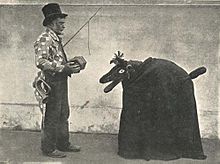
Practitioners of hoodening, a folk custom found in Kent, southeastern England, in 1909
These festivals and parades, with a target audience of people who do non vest to the social group, intersect with the interests and mission of public folklorists, who are engaged in the documentation, preservation, and presentation of traditional forms of folklife. With a bang-up in popular interest in folk traditions, these community celebrations are condign more numerous throughout the western globe. While ostensibly parading the diversity of their customs, economic groups accept discovered that these folk parades and festivals are expert for concern. All shades of people are out on the streets, eating, drinking and spending. This attracts support non only from the business community, but also from federal and state organizations for these local street parties.[37] Paradoxically, in parading multifariousness within the community, these events have come to authenticate truthful community, where business interests ally with the varied (folk) social groups to promote the interests of the community as a whole.
This is only a pocket-size sampling of types and examples of customary lore.
- Amish
- Barn raising
- Birthday
- Cakewalk
- Cat's cradle
- Chaharshanbe Suri
- Christmas
- Crossed fingers
- Folk trip the light fantastic toe
- Folk drama
- Folk medicine
- Giving the finger
- Halloween
- Hoodening
- Gestures
- Groundhog Day
- Louisiana Creole people
- Mime
- Native Hawaiians
- Ouiji board
- Powwows
- Practical jokes
- Saint John's Eve
- Shakers
- Symbols
- Thanksgiving
- Thumbs down
- Trick or Treating
- Whaling
- Yo-yos
Childlore and games [edit]

Childlore is a distinct branch of folklore that deals with activities passed on by children to other children, away from the influence or supervision of an developed.[38] Children's folklore contains artifacts from all the standard folklore genres of verbal, fabric, and customary lore; it is however the child-to-child conduit that distinguishes these artifacts. For childhood is a social group where children teach, learn and share their own traditions, flourishing in a street civilisation outside the purview of adults. This is also ideal where it needs to be collected; equally Iona and Peter Opie demonstrated in their pioneering book Children's Games in Street and Playground.[21] Hither the social group of children is studied on its ain terms, not as a derivative of adult social groups. It is shown that the culture of children is quite distinctive; it is generally unnoticed past the sophisticated globe of adults, and quite equally trivial affected by information technology.[39]
Of particular involvement to folklorists here is the mode of transmission of these artifacts; this lore circulates exclusively within an informal pre-literate children's network or folk group. Information technology does not include artifacts taught to children past adults. All the same children can take the taught and teach it further to other children, turning information technology into childlore. Or they can take the artifacts and turn them into something else; then Old McDonald'southward subcontract is transformed from fauna noises to the scatological version of animal poop. This childlore is characterized past "its lack of dependence on literary and fixed form. Children…operate among themselves in a world of informal and oral advice, unimpeded by the necessity of maintaining and transmitting data by written means.[40] This is as close as folklorists can come to observing the transmission and social part of this folk knowledge before the spread of literacy during the 19th century.
As we have seen with the other genres, the original collections of children's lore and games in the 19th century was driven by a fear that the civilization of childhood would dice out.[41] Early folklorists, among them Alice Gomme in United kingdom and William Wells Newell in the United States, felt a demand to capture the unstructured and unsupervised street life and activities of children before information technology was lost. This fear proved to be unfounded. In a comparison of whatsoever mod school playground during recess and the painting of "Children's Games" by Pieter Breugel the Elder nosotros can see that the activeness level is similar, and many of the games from the 1560 painting are recognizable and comparable to mod variations still played today.
These same artifacts of childlore, in innumerable variations, also continue to serve the same function of learning and practicing skills needed for growth. Then bouncing and swinging rhythms and rhymes encourage development of rest and coordination in infants and children. Verbal rhymes like Peter Piper picked... serve to increase both the oral and aural acuity of children. Songs and chants, accessing a different part of the brain, are used to memorize series (Alphabet song). They also provide the necessary vanquish to complex physical rhythms and movements, be it hand-clapping, bound roping, or brawl bouncing. Furthermore, many physical games are used to develop strength, coordination and endurance of the players. For some team games, negotiations about the rules tin run on longer than the game itself equally social skills are rehearsed.[42] Even as nosotros are but now uncovering the neuroscience that undergirds the developmental part of this childlore, the artifacts themselves have been in play for centuries.
Below is listed just a small sampling of types and examples of childlore and games.
- Buck buck
- Counting rhymes
- Dandling rhymes
- Finger and toe rhymes
- Counting-out games
- Dreidel
- Eeny, meeny, miny, moe
- Games
- Traditional games
- London Bridge Is Falling Downward
- Lullabies
- Nursery rhymes
- Playground songs
- Ball-billowy rhymes
- Rhymes
- Riddles
- Band a Band o Roses
- Leap-rope rhymes
- Stickball
- Street games
Folk history [edit]
A case has been made for because folk history as a singled-out sub-category of folklore, an idea that has received attention from such folklorists as Richard Dorson. This bailiwick is represented in The Sociology Historian, an almanac journal sponsored by the History and Folklore Department of the American Folklore Society and concerned with the connections of folklore with history, also as the history of folklore studies.[43]
The study of folk history is especially well developed in Republic of ireland, where the Handbook of Irish Folklore (the standard volume used by field workers of the Irish Sociology Commission) recognizes "historical tradition" as a separate category, traditionally referred to equally seanchas.[44] Henry Glassie made a pioneering contribution in his classic study, Passing the Time in Ballymenone.[45] Another notable exponent is historian Guy Beiner who has presented in-depth studies of Irish folk history, identifying a number of characteristic genres for what he has named "history telling", such equally stories (divided into tales and "mini-histories"), songs and ballads (particularly rebel songs), poems, rhymes, toasts, prophecies, proverbs and sayings, identify-names, and a variety of commemorative ritual practices. These are oftentimes recited by dedicated storytellers (seanchaithe) and folk historians (staireolaithe).[46] Beiner has since adopted the term vernacular historiography in an endeavour to motility beyond the confines of "the artificial divides between oral and literary cultures that lie at the heart of conceptualizations of oral tradition".[47]
Folklore performance in context [edit]
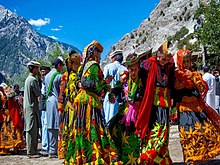
Folk-dance-kalash in Pakistan

Lacking context, folklore artifacts would be uninspiring objects without whatsoever life of their ain. Information technology is only through functioning that the artifacts come alive as an active and meaningful component of a social group; the intergroup communication arises in the performance and this is where transmission of these cultural elements takes place. American folklorist Roger D. Abrahams has described it thus: "Folklore is folklore simply when performed. As organized entities of performance, items of sociology have a sense of control inherent in them, a power that can be capitalized upon and enhanced through effective performance."[48] Without transmission, these items are non folklore, they are just individual quirky tales and objects.
This understanding in folkloristics but occurred in the second half of the 20th century, when the two terms "folklore performance" and "text and context" dominated discussions amongst folklorists. These terms are not contradictory or even mutually exclusive. As borrowings from other fields of study, one or the other linguistic formulation is more appropriate to any given discussion. Performance is frequently tied to verbal and customary lore, whereas context is used in discussions of material lore. Both formulations offering different perspectives on the same folkloric agreement, specifically that folklore artifacts need to remain embedded in their cultural environment if we are to gain insight into their meaning for the community.
The concept of cultural (folklore) performance is shared with ethnography and anthropology among other social sciences. The cultural anthropologist Victor Turner identified four universal characteristics of cultural performance: playfulness, framing, the use of symbolic language, and employing the subjunctive mood.[49] In viewing the performance, the audience leaves the daily reality to move into a mode of make-believe, or "what if?" It is self-evident that this fits well with all types of verbal lore, where reality has no place amid the symbols, fantasies, and nonsense of traditional tales, proverbs, and jokes. Customs and the lore of children and games also fit easily into the language of a sociology functioning.
Material civilization requires some moulding to plow it into a functioning. Should we consider the performance of the creation of the artifact, as in a quilting political party, or the performance of the recipients who use the quilt to comprehend their union bed? Here the language of context works better to describe the quilting of patterns copied from the grandmother, quilting equally a social event during the wintertime months, or the gifting of a quilt to signify the importance of the consequence. Each of these—the traditional blueprint called, the social event, and the gifting—occur within the broader context of the community. Even so, when considering context, the structure and characteristics of performance can exist recognized, including an audience, a framing result, and the use of decorative figures and symbols, all of which go beyond the utility of the object.
Backstory [edit]
Earlier the 2d Globe War, folk artifacts had been understood and collected as cultural shards of an earlier time. They were considered individual vestigial artifacts, with petty or no function in the contemporary culture. Given this understanding, the goal of the folklorist was to capture and document them before they disappeared. They were collected with no supporting data, spring in books, archived and classified more or less successfully. The Celebrated–Geographic Method worked to isolate and rail these collected artifacts, more often than not verbal lore, across infinite and fourth dimension.
Following the Second World War, folklorists began to articulate a more holistic approach toward their subject matter. In tandem with the growing sophistication in the social sciences, attention was no longer express to the isolated artifact, but extended to include the artifact embedded in an agile cultural environment. One early proponent was Alan Dundes with his essay "Texture, Text and Context", first published 1964.[50] A public presentation in 1967 by Dan Ben-Amos at the American Folklore Society brought the behavioral arroyo into open debate amongst folklorists. In 1972 Richard Dorson called out the "immature Turks" for their motion toward a behavioral approach to folklore. This approach "shifted the conceptualization of folklore equally an extractable detail or 'text' to an emphasis on folklore as a kind of human beliefs and communication. Conceptualizing folklore as behavior redefined the chore of folklorists..."[51] [notation half dozen]
Sociology became a verb, an action, something that people do, not just something that they have.[52] It is in the functioning and the active context that sociology artifacts get transmitted in informal, direct communication, either verbally or in sit-in. Performance includes all the dissimilar modes and manners in which this transmission occurs.
Tradition-bearer and audience [edit]
Transmission is a communicative process requiring a binary: i individual or group who actively transmits information in some form to another individual or group. Each of these is a defined role in the folklore process. The tradition-bearer[53] is the individual who actively passes along the knowledge of an antiquity; this tin can be either a mother singing a lullaby to her baby, or an Irish trip the light fantastic toe troupe performing at a local festival. They are named individuals, normally well known in the community as knowledgeable in their traditional lore. They are not the bearding "folk", the nameless mass without of history or individuality.
The audition of this performance is the other one-half in the transmission process; they heed, watch, and remember. Few of them volition become active tradition-bearers; many more will be passive tradition-bearers who maintain a retentiveness of this specific traditional antiquity, in both its presentation and its content.
There is agile communication between the audience and the performer. The performer is presenting to the audience; the audience in turn, through its deportment and reactions, is actively communicating with the performer.[54] The purpose of this performance is not to create something new but to re-create something that already exists; the performance is words and actions which are known, recognized and valued by both the performer and the audience. For sociology is start and foremost remembered behavior. As members of the aforementioned cultural reference group, they identify and value this functioning as a piece of shared cultural knowledge.
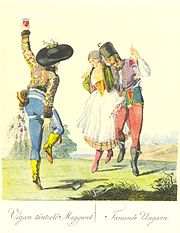
Dancing Hungarians by J. B. Heinbucher, 1816
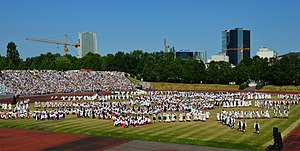
Some elements of folk culture might be in the eye of local culture and an import office of cocky-identity. For case folk trip the light fantastic is highly popular in Estonia and information technology has evolved into a sort of a national sport.[annotation 7] XIX Estonian Dance Celebration in 2015 that was held together with Estonian Song Festival.
Framing the functioning [edit]
To initiate the performance, at that place must exist a frame of some sort to indicate that what is to follow is indeed performance. The frame brackets it every bit exterior of normal discourse. In customary lore such as life cycle celebrations (ex. birthday) or trip the light fantastic performances, the framing occurs as function of the event, often marked past location. The audience goes to the outcome location to participate. Games are divers primarily by rules,[55] it is with the initiation of the rules that the game is framed. The folklorist Barre Toelken describes an evening spent in a Navaho family unit playing string figure games, with each of the members shifting from performer to audience equally they create and display different figures to each other.[56]
In verbal lore, the performer will offset and end with recognized linguistic formulas. An piece of cake instance is seen in the common introduction to a joke: "Have you heard the one...", "Joke of the twenty-four hours...", or "An elephant walks into a bar". Each of these signals to the listeners that the post-obit is a joke, not to exist taken literally. The joke is completed with the dial line of the joke. Some other traditional narrative mark in English is the framing of a fairy tale betwixt the phrases "One time upon a time" and "They all lived happily ever later on." Many languages have like phrases which are used to frame a traditional tale. Each of these linguistic formulas removes the bracketed text from ordinary discourse, and marks information technology as a recognized form of stylized, formulaic communication for both the performer and the audience.
In the subjunctive voice [edit]
Framing as a narrative device serves to point to both the story teller and the audience that the narrative which follows is indeed a fiction (exact lore), and not to be understood as historical fact or reality. Information technology moves the framed narration into the subjunctive mood, and marks a infinite in which "fiction, history, story, tradition, art, pedagogy, all exist inside the narrated or performed expressive 'issue' exterior the normal realms and constraints of reality or fourth dimension."[57] This shift from the realis to the irrealis mood is understood by all participants inside the reference group. It enables these fictional events to incorporate meaning for the group, and can pb to very existent consequences.[58]
Anderson's police of motorcar-correction [edit]
The theory of self-correction in folklore transmission was beginning articulated past the folklorist Walter Anderson in the 1920s; this posits a feedback mechanism which would proceed folklore variants closer to the original grade.[59] [note eight] This theory addresses the question well-nigh how, with multiple performers and multiple audiences, the antiquity maintains its identity across fourth dimension and geography. Anderson credited the audience with censoring narrators who deviated besides far from the known (traditional) text.[60]
Any performance is a two-mode advice process. The performer addresses the audience with words and actions; the audience in turn actively responds to the performer. If this performance deviates too far from audition expectations of the familiar folk artifact, they volition respond with negative feedback. Wanting to avoid more than negative reaction, the performer volition arrange his operation to conform to audience expectations. "Social reward by an audience [is] a major factor in motivating narrators..."[61] It is this dynamic feedback loop between performer and audience which gives stability to the text of the functioning.[62]
In reality, this model is not and so simplistic; there are multiple redundancies in the active sociology process. The performer has heard the tale multiple times, he has heard it from unlike story tellers in multiple versions. In turn, he tells the tale multiple times to the aforementioned or a different audition, and they expect to hear the version they know. This expanded model of redundancy in a not-linear narrative process makes it hard to introduce during any single functioning; cosmetic feedback from the audience volition be immediate.[63] "At the heart of both autopoetic self-maintenance and the 'virality' of meme transmission... it is enough to assume that some sort of recursive action maintains a degree of integrity [of the artifact] in certain features ... sufficient to allow us to recognize it as an instance of its type."[64]
Context of material lore [edit]
For material folk artifacts, it becomes more fruitful to render to the terminology of Alan Dundes: text and context. Here the text designates the physical artifact itself, the single item fabricated by an private for a specific purpose. The context is then unmasked by ascertainment and questions concerning both its production and its usage. Why was information technology made, how was it made, who will employ it, how volition they utilize it, where did the raw materials come from, who designed information technology, etc. These questions are limited only by the skill of the interviewer.
In his study of southeastern Kentucky chair makers, Michael Owen Jones describes production of a chair within the context of the life of the craftsman.[65] For Henry Glassie in his study of Folk Housing in Eye Virginia, the investigation concerns the historical pattern he finds repeated in the dwellings of this region: the house is planted in the mural but equally the landscape completes itself with the house.[66] The artisan in his roadside stand up or shop in the nearby town wants to brand and display products which appeal to customers. At that place is "a craftsperson's eagerness to produce 'satisfactory items' due to a close personal contact with the client and expectations to serve the client once again." Here the role of consumer "... is the bones force responsible for the continuity and discontinuity of behavior."[61]
In material culture the context becomes the cultural environs in which the object is fabricated (chair), used (house), and sold (wares). None of these artisans is "anonymous" folk; they are individuals making a living with the tools and skills learned inside and valued in the context of their customs.
Toelken's conservative-dynamic continuum [edit]
No 2 performances are identical. The performer attempts to keep the performance inside expectations, but this happens despite a multitude of irresolute variables. He has given this operation one time more or less, the audience is different, the social and political environment has inverse. In the context of textile civilisation, no two hand-crafted items are identical. Sometimes these deviations in the performance and the production are unintentional, just role of the process. But sometimes these deviations are intentional; the performer or artisan want to play with the boundaries of expectation and add their ain creative touch. They perform within the tension of conserving the recognized class and adding innovation.
The folklorist Barre Toelken identifies this tension as "a combination of both changing ('dynamic') and static ('conservative') elements that evolve and alter through sharing, communication and performance."[67] Over time, the cultural context shifts and morphs: new leaders, new technologies, new values, new awareness. As the context changes, so must the artifact, for without modifications to map existing artifacts into the evolving cultural mural, they lose their meaning. Joking every bit an active course of verbal lore makes this tension visible as joke cycles come up and become to reflect new problems of business organization. One time an artifact is no longer applicative to the context, transmission becomes a nonstarter; it loses relevancy for a contemporary audition. If it is not transmitted, so it is no longer folklore and becomes instead an historic relic.[61]
In the electronic age [edit]
Folklorists have begun to place how the appearance of electronic communications will modify and change the performance and transmission of sociology artifacts. It is articulate that the internet is modifying folkloric process, not killing it, as despite the historic clan between folklore and anti-modernity, people keep to use traditional expressive forms in new media, including the internet.[68] Jokes and joking are equally plentiful as ever both in traditional confront-to-face interactions and through electronic manual. New communication modes are also transforming traditional stories into many dissimilar configurations. The fairy tale Snow White is now offered in multiple media forms for both children and adults, including a television show and video game.[ commendation needed ]
See also [edit]
- Applied folklore
- Costumbrismo
- Family folklore
- Folkloristics
- Folklore studies
- Intangible cultural heritage
- Legend
- Memetics
- Public folklore
- The law of conservation of misery
Notes [edit]
- ^ The discussion folkloristics is favored by Alan Dundes, and used in the championship of his publication Dundes 1978; the term folklore studies is divers and used by Simon Bronner, encounter Bronner 1986, p. xi.
- ^ Contributors of this result were, amidst others, Claire Farrer, Joan North. Radner, Susan Lanser, Elaine Lawless, and Jeannie B. Thomas.
- ^ Vladimir Propp commencement defined a compatible structure in Russian fairy tales in his groundbreaking monograph Morphology of the Folktale, published in Russian in 1928. Run across Propp 1928
- ^ Henry Glassie, a distinguished folklorist studying applied science in cultural context, notes that in Turkish one give-and-take, sanat, refers to all objects, non distinguishing betwixt fine art and craft. The latter distinction, Glassie emphasizes, is not based on medium but on social course. This raises the question equally to the divergence betwixt arts and crafts; is the difference found merely in the labeling?
- ^ The folklorist Archie Green specialized in workers' traditions and the lore of labor groups.
- ^ A more all-encompassing discussion of this can be found in "The 'Text/Context' Controversy and the Emergence of Behavioral Approaches in Folklore", Gabbert 1999
- ^ See Folk dance Estonica
- ^ Anderson is best known for his monograph Kaiser und Abt (Folklore Fellows' Communications 42, Helsinki 1923) on folktales of type AT 922.
Footnotes [edit]
- ^ A legend is a traditional story sometimes popularly regarded as historical but unauthenticated.
- ^ "Folklore Programs in the Usa and Canada". cfs.osu.edu. Ohio Land University. Archived from the original on 8 November 2018. Retrieved 21 August 2020.
- ^ "William John Thoms". The Folklore Society. Archived from the original on 15 July 2020. Retrieved xv July 2020.
- ^ "lore – Definition of lore in English language". Oxford Dictionaries . Retrieved 8 October 2017.
- ^ Dundes 1969, p. 13, footnote 34
- ^ Wilson 2006, p. 85
- ^ a b Dundes 1980, p. 7
- ^ a b Bauman 1971
- ^ Dundes 1971
- ^ Dundes 1965, p. ane
- ^ Schreiter 2015, p.[ page needed ].
- ^ Sims & Stephens 2005, pp. 7–8
- ^ Noyes 2012, p. 20
- ^ Noyes 2012, pp. xv–16
- ^ Zumwalt & Dundes 1988
- ^ "Public Constabulary 94-201: The Cosmos of the American Folklife Center". loc.gov/folklife. Archived from the original on 28 September 2017. Retrieved eight Oct 2017.
- ^ Hufford 1991
- ^ Bascom 1954.
- ^ Dundes 1980, p. 8
- ^ Bauman 1971, p. 41
- ^ a b Opie & Opie 1969
- ^ Georges & Jones 1995, pp. 10–12
- ^ Toelken 1996, p. 184
- ^ Sims & Stephens 2005, p. 17
- ^ a b Dorson 1972, p. two
- ^ Sims & Stephens 2005, p. 13
- ^ Georges & Jones 1995, pp. 112–113
- ^ Vlach 1997
- ^ Roberts 1972, pp. 236 ff
- ^ Schiffer 2000.
- ^ Roberts 1972, pp. 236 ff, 250
- ^ "Fabric Culture". American Folklife Center. The Library of Congress. 29 October 2010. Archived from the original on 20 August 2017. Retrieved 8 October 2017.
- ^ a b Sweterlitsch 1997, p. 168
- ^ Sims & Stephens 2005, p. 16
- ^ Dorson 1972, p. iv
- ^ Bauman 1971, p. 45
- ^ Sweterlitsch 1997, p. 170
- ^ Grider 1997, p. 123
- ^ Grider 1997, p. 125
- ^ Grider 1997
- ^ Grider 1997, p. 127
- ^ Georges & Jones 1995, p. 243–254
- ^ "The Folklore Historian". American Folklore Society.
- ^ Ó Súilleabháin 1942, p. 520–547.
- ^ Glassie 1982a.
- ^ Beiner 2007, p. 81–123
- ^ Beiner 2018, p. 13–fourteen
- ^ Abrahams 1972, p. 35
- ^ Ben-Amos 1997a, pp. 633–634
- ^ Dundes 1980
- ^ Gabbert 1999, p. 119
- ^ Bauman & Paredes 1972, p. xv
- ^ Ben-Amos 1997b
- ^ Sims & Stephens 2005, p. 127
- ^ Beresin 1997, p. 393
- ^ Toelken 1996, pp. 118 ff
- ^ Sims & Stephens 2005, p. 141
- ^ Ben-Amos 1997a
- ^ Dorst 2016, p. 131
- ^ El-Shamy 1997
- ^ a b c El-Shamy 1997, p. 71
- ^ Sims & Stephens 2005, p. 127
- ^ Dorst 2016, pp. 131–132
- ^ Dorst 2016, p. 138
- ^ Jones 1975, p.[ page needed ].
- ^ Glassie 1983, p. 125.
- ^ Sims & Stephens 2005, p. 10
- ^ Bare & Howard 2013, p. 4, 9, xi
References [edit]
- Anderson, Walter (1923). "Kaiser und Abt. Die Geschichte eines Schwanks". FF Communications. 42.
- Bascom, William R. (1954). "Four Functions of Folklore". The Journal of American Sociology. American Folklore Society. 67 (266): 333–349. doi:10.2307/536411. JSTOR 536411.
- Bauman, Richard (1971). "Differential Identity and the Social Base of operations of Folklore". Journal of American Folklore. 84 (331): 31–41. doi:10.2307/539731. JSTOR 539731.
- Bauman, Richard; Paredes, Américo, eds. (1972). Toward New Perspectives in Folklore. Bloomington, IN: Trickster Printing.
- Abrahams, Roger D. (1972). "Personal Power and Social Restraint". In Bauman, Richard; Paredes, Américo (eds.). Toward New Perspectives in Folklore. Bloomington, IN: Trickster Printing. pp. xx–39.
- Ben-Amos, Dan (1972). "Toward a Definition of Folklore in Context". In Bauman, Richard; Paredes, Américo (eds.). Toward New Perspectives in Folklore. Bloomington, IN: Trickster Printing. pp. 3–15.
- Bauman, Richard (1975). "Exact Fine art every bit Performance". American Anthropologist. New Serial. 77 (2): 290–311. doi:10.1525/aa.1975.77.2.02a00030. JSTOR 674535.
- Bauman, Richard (2008). "The Philology of the Vernacular". Journal of Sociology Research. 45 (1): 29–36. doi:ten.2979/JFR.2008.45.one.29. JSTOR 40206961. S2CID 144402948.
- Beiner, Guy (2007). Remembering the Year of the French: Irish gaelic Folk History and Social Memory. Madison: University of Wisconsin Printing. ISBN978-0-299-21824-9.
- Beiner, Guy (2018). Forgetful Remembrance: Social Forgetting and Vernacular Historiography of a Rebellion in Ulster. Oxford: Oxford University Press. ISBN978-0-xix-874935-six.
- Ben-Amos, Dan (1985). "On the Final [s] in 'Folkloristics'". Journal of American Folklore. 98 (389): 334–336. doi:10.2307/539940. JSTOR 539940.
- Bendix, Regina (1997). In Search of Authenticity: The Formation of Sociology Studies. Madison: University of Wisconsin Printing. ISBN978-0-299-15544-5.
- Bendix, Regina; Hasan-Rokem, Galit, eds. (2012). A Companion to Folklore. Malden, MA: Wiley-Blackwell. ISBN978-one-4051-9499-0.
- Noyes, Dorothy (2012). "The Social Base of Folklore". In Bendix, Regina; Hasan-Rokem, Galit (eds.). A Companion to Folklore. Malden, MA: Wiley-Blackwell. pp. 13–39.
- Bare, Trevor J., ed. (2009). Folklore and the Internet: Vernacular Expression in a Digital Earth. Logan, UT: Utah State University Press. ISBN978-0-87421-750-six.
- Frank, Russel (2009). "The Forward every bit Sociology: Studying E-Mailed Humor". In Bare, Trevor J. (ed.). Folklore and the Net: Vernacular Expression in a Digital World. Logan, UT: Utah State University Press. pp. 98–122.
- Blank, Trevor J.; Howard, Robert Glenn, eds. (2013). Tradition in the 21st Century: Locating the Role of the By in the Nowadays. Logan, UT: Utah State University Press.
- Bronner, Simon J. (1986). American Folklore Studies: An Intellectual History. Lawrence, KS: University Press of Kansas. ISBN978-0-7006-0313-viii.
- Bronner, Simon J. (1998). Following Tradition: Folklore in the Soapbox of American Civilisation. Logan, UT: Utah Country University Printing. ISBN978-0-87421-239-half-dozen.
- Bronner, Simon J. (2017). Folklore: The Basics. London; New York: Routledge. ISBN978-1-138-77495-seven.
- Bronner, Simon J., ed. (2007). The Significant of folklore: the Analytical Essays of Alan Dundes. Logan, UT: Utah Country University Press. ISBN978-0-87421-683-seven.
- Brunvand, Jan Harold (1968). The Written report of American Folklore . New York; London: Due west.Due west. Norton. ISBN978-0-39309957-vii.
- Burns, Thomas A. (1977). "Folkloristics: A Conception of Theory". Western Folklore. 36 (2): 109–34. doi:10.2307/1498964. JSTOR 1498964.
- Del-Rio-Roberts, Maribel (2010). "A Guide to Conducting Ethnographic Enquiry: A Review of Ethnography: Stride-by-Footstep (third ed.) by David K. Fetterman" (PDF). The Qualitative Report. fifteen (3): 737–49.
- Deloria, Vine (1994). God Is Cherry-red: A Native View of Religion. Golden, CO: Fulcrum Publishing. ISBN978-1-55591-176-eight.
- Dorson, Richard M., ed. (1972). Folklore and Folklife: an Introduction . Chicago: University of Chicago Press. ISBN9780226158709.
- Roberts, Warren (1972). "Folk Crafts". In Dorson, Richard Chiliad. (ed.). Folklore and Folklife: an Introduction. Chicago: University of Chicago Printing. pp. 233–252. ISBN9780226158709.
- Dorson, Richard G. (1976). Folklore and Fakelore: Essays Toward a Discipline of Folk Studies. Cambridge; London: Harvard University Press. ISBN978-0-674-33020-7.
- Dorst, John (1990). "Tags and Burners, Cycles and Networks: Folklore in the Telectronic Age". Journal of Folklore Research. 27 (3): 61–108.
- Dorst, John (2016). "Folklore'due south Cybernetic Imaginary, or, Unpacking the Obvious". Journal of American Folklore. 129 (512): 127–145. doi:ten.5406/jamerfolk.129.512.0127. JSTOR 10.5406/jamerfolk.129.512.0127. S2CID 148523716.
- Dundes, Alan (1965). The Study of Sociology . Englewood Cliffs, NJ: Prentice-Hall. ISBN978-0-xiii-858944-viii.
- Dundes, Alan (1969). "The Devolutionary Premise in Folklore Theory". Journal of the Folklore Institute. six (1): 5–19. doi:x.2307/3814118. JSTOR 3814118.
- Dundes, Alan (1971). "Folk Ideas as Units of Worldview". Journal of American Folklore. 84 (331): 93–103. doi:ten.2307/539737. JSTOR 539737.
- Dundes, Alan (1978). Essays in Folkloristics (Kirpa Dai series in folklore and anthropology). Folklore Institute.
- Dundes, Alan (1978a). "Into the Endzone for a Touchdown: A Psychoanalytic Consideration of American Football". Western Folklore. 37 (ii): 75–88. doi:10.2307/1499315. JSTOR 1499315.
- Dundes, Alan (1980). Interpreting Sociology. Bloomington and Indianapolis: Indiana University Press. ISBN978-0-253-14307-5.
- Dundes, Alan (1984). Life Is like a Chicken Coop Ladder. A Portrait of German Civilization through Sociology . New York: Columbia University Printing. ISBN978-0-231-05494-2.
- Dundes, Alan (2005). "Folkloristics in the Twenty-First Century (AFS Invited Presidential Plenary Address, 2004)". Journal of American Sociology. 118 (470): 385–408. doi:10.1353/jaf.2005.0044. JSTOR 4137664. S2CID 161269637.
- Ellis, Neb (2002). "Making a Big Apple Crumble". New Directions in Folklore (6). Archived from the original on 2016-10-22. Retrieved 2016-12-19 .
- Fixico, Donald L. (2003). The American Indian Mind in a Linear World. New York: Routledge. ISBN978-0-415-94456-iv.
- Gabbert, Lisa (1999). "The "Text/Context" Controversy and the Emergence of Behavioral Approaches in Sociology" (PDF). Folklore Forum. 30 (112): 119–128.
- Gazin-Schwartz, Amy (2011). "Myth and Sociology". In Insoll, Timothy (ed.). The Oxford Handbook of the Archaeology of Ritual and Religion. Oxford: Oxford Academy Press. pp. 63–75. ISBN978-0-19-923244-4.
- Genzuk, Michael (2003). "A Synthesis of Ethnographic Research" (PDF). Occasional Papers Series. Center for Multilingual, Multicultural Enquiry. University of Southern California. Retrieved 12 July 2020.
- Georges, Robert A.; Jones, Michael Owen (1995). Folkloristics : an Introduction. Bloomington and Indianapolis: Indiana University Printing. ISBN978-0-253-20994-8.
- Glassie, Henry (1975). Folk Housing in Eye Virginia: A Structural Analysis of Celebrated Artifacts. Knoxville: University of Tennessee Press.
- Glassie, Henry (1982a). Passing the Fourth dimension in Ballymenone: Culture and History of an Ulster Community. Philadelphia: University of Pennsylvania Press.
- Glassie, Henry (1982b). Irish Folk History: Folktales from the North. Dublin: O'Brien Press.
- Glassie, Henry (1983). "The Moral Lore of Sociology" (PDF). Sociology Forum. 16 (2): 123–151.
- Goody, Jack (1977). The Domestication of the Roughshod Mind. Cambridge: Cambridge University Printing. ISBN978-0-521-29242-9.
- Green, Thomas A., ed. (1997). Folklore: An Encyclopedia of Beliefs, Community, Tales, Music, and Art. Santa Barbara, CA: ABC-CLIO. ISBN978-0-87436-986-ane.
- Beresin, Ann Richman. "Games". In Green (1997), pp. 393–400.
- Ben-Amos, Dan (1997a). "Performance". in Greenish (1997), pp. 630–635.
- Ben-Amos, Dan (1997b). "Tradition-Bearer". in Green (1997), pp. 802–803.
- El-Shamy, Hasan. "Audience". In Green (1997), pp. 70–72.
- Grider, Sylvia. "Children's Sociology". In Greenish (1997), pp. 123–128.
- Sweterlitsch, Richard. "Custom". In Green (1997), pp. 168–172.
- Vlach, John. "Material Culture". In Dark-green (1997), pp. 540–544.
- Hufford, Mary (1991). "American Folklife: A Commonwealth of Cultures". Publication of the American Folklife Center. 17: ane–23.
- Jones, Michael Owen (1975). The Hand Made Object and Its Maker . Berkeley and Los Angeles: University of California Press. ISBN9780520026971.
- Kirshenblatt-Gimblett, Barbara (1985). "Di folkloristik: A Good Yiddish Discussion". Journal of American Folklore. 98 (389): 331–334. doi:ten.2307/539939. JSTOR 539939.
- Kirshenblatt-Gimblett, Barbara (September 1999). "Performance Studies". Rockefeller Foundation, Culture and Creativity.
- Stonemason, Bruce Lionel (Oct 1998). "Eastward-Texts: The Orality and Literacy Issue Revisited". Oral Tradition. Columbia, MO: Centre for Studies in Oral Tradition. 13 (two).
- Noyes, Dorothy (2003). "Group". In Feintuch, Burt (ed.). Viii Words for the Written report of Expressive Culture. Academy of Illinois Press. pp. 7–41. ISBN978-0-252-07109-half-dozen. JSTOR 10.5406/j.ctt2ttc8f.5.
- Opie, Iona; Opie, Peter (1969). Children'southward Games in Street and Playground. Oxford University Press.
- Oring, Elliott (1986). Folk Groups and Sociology Genres: An Introduction. Logan, UT: Utah State University Printing. ISBN978-0-87421-128-iii.
- Ó Súilleabháin, Seán (1942). A Handbook of Irish gaelic Sociology. Dublin: The Education Company of Ireland Ltd.
- Propp, Vladimir (1928). Morphology of the Folktale. Leningrad.
- Raskin, Victor, ed. (2008). Primer of Humor Inquiry: Sense of humour Enquiry 8. Berlin; New York: Mouton de Gruyter.
- Schiffer, Michael B. (October 2000). "Material Culture (review)". Engineering and Culture. 41 (4): 791–793. doi:10.1353/tech.2000.0178. S2CID 109662410.
- Schmidt-Lauber, Brigitta (2012-03-22). "Seeing, Hearing, Feeling, Writing". In Bendix, Regina; Hasan-Rokem, Galit (eds.). A Companion to Folklore. Chichester, United kingdom: John Wiley & Sons, Ltd. pp. 559–578. doi:10.1002/9781118379936.ch29. ISBN978-1-118-37993-six.
- Schreiter, Robert J. (2015). Constructing Local Theologies (30th Ceremony ed.). Orbis Books. ISBN978-one-62698-146-1. OCLC 1054909858.
- Sims, Martha; Stephens, Martine (2005). Living Sociology: Introduction to the Study of People and their Traditions. Logan, UT: Utah State University Press. ISBN978-0-87421-611-0.
- Šmidchens, Guntis (1999). "Folklorism Revisited". Journal of American Sociology Research. 36 (1): 51–seventy. JSTOR 3814813.
- Stahl, Sandra Dolby (1989). Literary Folkloristics and the Personal Narrative . Bloomington: Indiana University Printing. ISBN978-0-253-33515-9.
- Toelken, Barre (1996). The Dynamics of Folklore. Logan, UT: Utah State Academy Press. ISBN978-0-87421-203-7.
- Wilson, William A. (2006). Rudy, Jill Terry; Call, Diane (eds.). The Marrow of Human Feel: Essays on Folklore. Logan, UT: Utah Land University Press. ISBN978-0-87421-653-0. JSTOR j.ctt4cgkmk.
- Wolf-Knuts, Ulrika (1999). "On the history of comparison in folklore studies". Folklore Fellows' Summer Schoolhouse.
- Zumwalt, Rosemary Levy; Dundes, Alan (1988). American Folklore Scholarship: A Dialogue of Dissent. Indiana University Press.
- "Legend" definition in folktale | Dictionary.com [1]
External links [edit]
-
 Media related to Folklore at Wikimedia Commons
- ^ https://www.dictionary.com/browse/legend
Source: https://en.wikipedia.org/wiki/Folklore
0 Response to "ââ‹the Narratives That Make Up the Verbal Arts Include All of the Following Except"
Postar um comentário